Cliquez ici pour lire la version française de l’article
How do you convey the taste of wine through an image? How do you translate its aromas, texture, and the emotions it evokes without ever letting the viewer taste it? This is the challenge taken up by the animated adaptation of “The Drops of God”-a cult classic created by Tadashi Agi and Shu Okimoto-which is now embarking on a new chapter following the
original manga and an earlier live-action drama adaptation. To bring this new version to life, director Kenji Itoso enlisted a performer who already knows the character intimately: Kazuya Kamenashi, who played Shizuku Kanzuki in the 2009 live-action series and now lends him his voice. A fascinating parallel emerges between the actor and his character: just as
Shizuku gradually uncovers the secrets of wine, Kazuya Kamenashi was himself venturing into the world of voice acting for the first time.
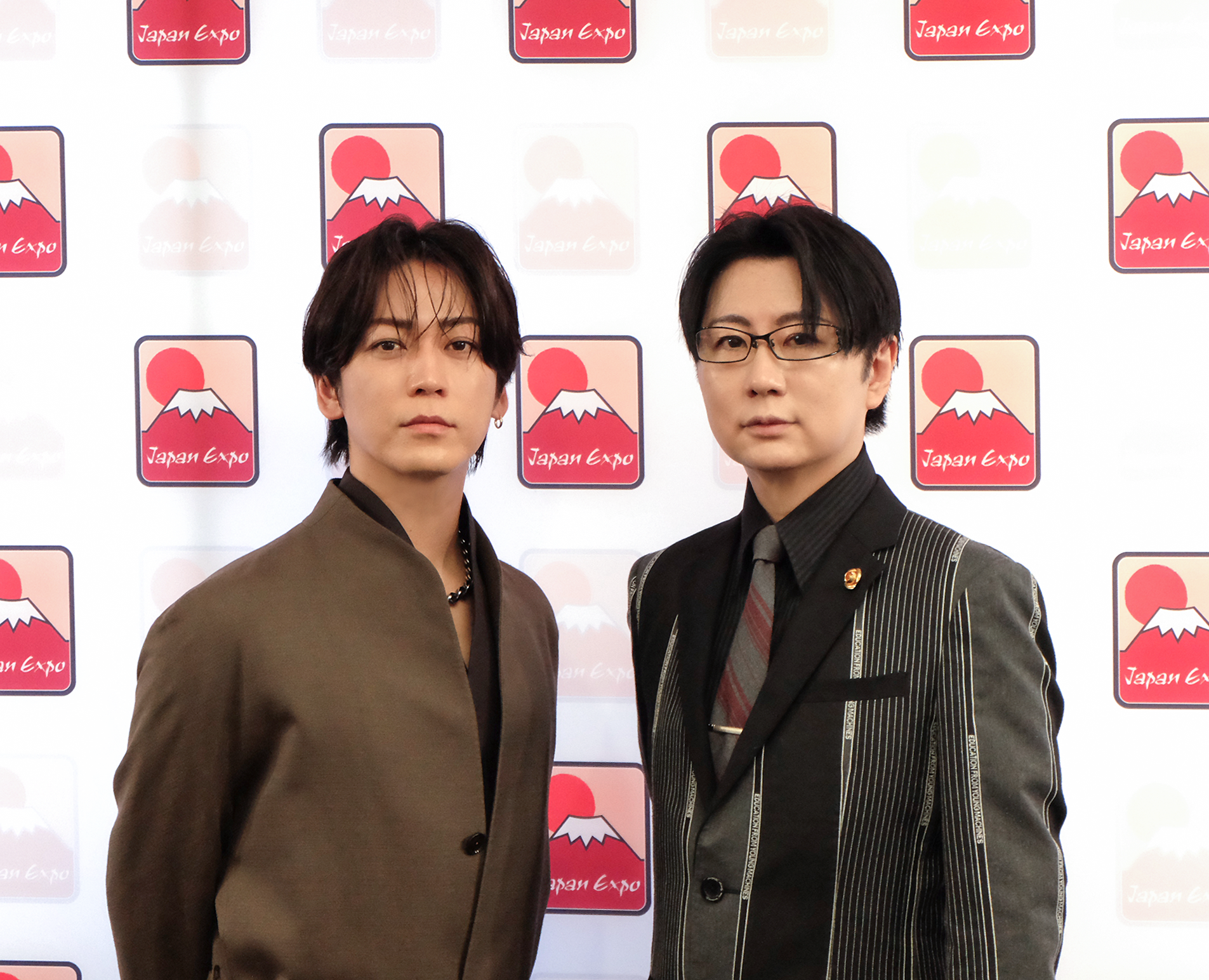
During their visit to Japan Expo, we met with Kenji Itoso and Kazuya Kamenashi to discuss this new adaptation, the challenge of giving wine a sensory reality through sound and imagery, and their personal connection to a work that so passionately blends oenology with human relationships. In a mix of interviews and press conferences, the two men also reflect on the project’s origins, the role of nostalgia in a contemporary adaptation, and the unique bond linking this work to France-the homeland of winemaking.
Could you introduce yourselves?
Kazuya Kamenashi: My name is Kamenashi, and I voice the character Shizuku in Kami no Shizuku (The Drops of God).
Kenji Itoso: I am Mr. Itoso, the director of The Drops of God.
The Drops of God is a highly acclaimed manga, but it is also a work that takes a very sensory approach to wine—making it notoriously difficult to adapt. Did you have any concerns when you started working on this project?
Kenji Itoso: Indeed, it was quite a challenge, especially since we decided—in agreement with the authors- to omit certain parts of the original story. We worked closely with the authors to create something that remained true to the spirit of the story, much like memories. However, conveying tastes, scents, aromas, and textures is genuinely difficult. So, striking the right balance between sound and visuals was crucial for us. We played with both elements to create a sense of aroma through the ears and the eyes instead of the nose.
Kazuya Kamenashi: It’s true that conveying the full range of sensations experienced on the palate when drinking wine was part of the challenge of this anime. All those aspects are what can create the “click”, or the moment of realization that opens the door to the world of wine and we wanted to find a way to visually convey those emotions.
The work has been around for over twenty years. How did you approach this adaptation to satisfy both long-time readers and audiences discovering The Drops of God for the first time?
Kenji Itoso: Of course, we wanted to satisfy long-time readers; but just as wine evolves, some of our choices also evolve over time and differ from the original work. At the same time, it was crucial to preserve the nostalgic aspect of the manga. This was one of the questions we had to answer: “What nostalgic elements could we include in the anime without them feeling out of place or distracting?” Why did we face that challenge? For example, let’s talk about the Alta building in Shinjuku, which appears in the manga. Since last year, this building no longer exists. But it serves as a vehicle for nostalgia awakening memories for many people. It is iconic enough to evoke that feeling. On the other hand, trends in Japan change rapidly. Popular places and cultural phenomena are constantly evolving. If we had adapted everything exactly as it was in the drama without taking those changes into consideration, modern audiences might not have been able to connect with it, as certain period-specific references could easily feel outdated today. So we had to strike a balance between preserving the elements that evoke nostalgia and reimagining them within a contemporary setting.
As a director, can you tell us what particularly appealed to you in Kamenashi Kazuya ?
Kenji Itoso: When preparing a series, it is important to look at all the works that have already been produced. Of course, there is the manga, but there is also the live-action series. As I researched The Drops of God, I gradually came to realize that the only person who could truly portray this role was Kazuya Kamenashi. I was fortunate that he accepted my offer.
In the same way that Kamenashi-san was discovering the world of voice acting, Shizuku himself was a beginner in learning about the taste of wine. This journey of discovery, this blossoming of knowledge about wine, can be paralleled with Kamenashi-san’s own discovery of voice acting. I felt there was a strong parallel to be drawn, both thematically and artistically. Another important point is that Shizuku comes from a well-to-do family, has received an excellent education, and carries himself with great elegance. I could also sense that same presence and dignity in Kamenashi-san. In that respect, he ticked every box for the role.
Mr. Kamenashi, how did you feel when you were offered the opportunity to voice Shizuku after you portrayed him in the live-action drama?
Kazuya Kamenashi: Above all, it came as a huge surprise, as I never imagined that I would be asked to take on this role again. It felt as though the wheel of fate had come full circle and brought me back to Shizuku. Having the opportunity to portray him once again shows just how strong the connection between us is.
At a press conference, director Kenji Itoso and voice actor Kazuya Kamenashi shared further details about the behind-the-scenes aspects of the animated series…
Hello and thank you for coming to Japan Expo. First of all, is it your first time coming to France?
Kenji Itoso: Personally, I’ve been to France several times before, both to take part in the Cannes Festival and for researches while preparing the anime adaptation of The Drops of God. That gave me the opportunity to visit various wineries.
Kazuya Kamenashi: My first trip to France was about twenty years ago. I also covered the Olympic Games in 2024. And I’ve also visited on my own with my mother on my personal time.
The initial manga, published between 2004 and 2010, has already been adapted into a drama. How did you approach this work when you decided to make an anime adaptation?
Kenji Itoso: Since the manga was first created, the world of wine has changed considerably. The value of different wines has changed, and it is also easier to buy wine around the world. What I noticed upon watching the drama starring Kamenashi Kazuya was that it didn’t necessarily focus on showcasing this other world through wine. What I felt was important to emphasize in the anime was wine’s texture and intrinsic value.
Mr Kamenashi, was it difficult to try out dubbing for the first time?
Kazuya Kamenashi: It was my very first experience, I discovered the job from A to Z as a beginner. But I had the chance to be really well supported by all the teams who worked on it.
Did you change your interpretation of the character compared with your role in the live-action series?
Kazuya Kamenashi: What was really different was my approach to acting. When I play a character in a live-action series, I create my own image of that character, and my performance grows from that image. Here, it was the exact opposite. The visual interpretation already existed, and I had to fit within it. I also had to convey emotions that were already predetermined, which is a major difference. I also needed to match Shizuku’s age as closely as possible, so I had to use a higher-pitched voice. Every time I entered the recording studio, I would warm up my voice with a few exercises to place it exactly where it needed to be.
Each episode adapts one volume of the manga. Was there a particular reason for moving at such a fast pace?
Kenji Itoso: The answer is actually quite simple. Very early in the production process, we decided that the adaptation would consist of 24 episodes spread across two seasons. We also needed to determine how we would work within that framework. Together with the original creators, we discussed the pacing of the adaptation. They suggested that we should approach the material differently during the adaptation process. We therefore decided to adapt one volume per episode, even though this means removing certain elements. This allowed us to immerse viewers fully in the world of The Drops of God while still covering all twelve challenges.
What was the most memorable moment during one of your recording sessions?
Kazuya Kamenashi: The emotional shifts were probably the most striking aspect. At one moment I would be crying, and just a few seconds later I’d have to cheerfully say, “Good morning!”. We record the scenes one after another, so you need to be able to switch emotions in less than a minute. That flexibility was something that really surprised me. Whenever I found myself in the recording studio alongside twenty or so professional voice actors, I couldn’t help thinking how incredible they were. Watching them move from one emotion to another so effortlessly left a lasting impression on me. Another memorable moment was when we all had to constantly switch between four microphones in a sort of endless back-and-forth. Reading our scripts while changing positions was actually quite fun. Since we were recording a party scene, the teams in the background were creating crowd noises, conversations, and various sound effects, making the atmosphere incredibly lively.
In your directing process, do you strictly follow the original manga, or do you allow yourself to add your own creative touch?
Kenji Itoso:First of all, we checked with the publishers to determine what we was allowed to do or not. They gave us complete creative freedom, just as they did for the live-action series. Even so, I wanted to remain as faithful as possible to the original work. There were certain elements that had to be omitted for the adaptation, but if we’re talking about new material, we can mention the original wine challenges that were added. These were created by the manga authors themselves. Visually speaking, we also made some adjustments. For example, we redesigned Miyabi to look cuter and younger so that she would be better suited to animation. We also approached the soundtrack differently : every scene has its own musical composition, much like in a movie.
Were you already familiar with the manga before working on this project? What do you think is its greatest strength?
Kenji Itoso: Yes, I had already read the manga and was a huge fan of it. However, I never imagined that one day I would have the opportunity to adapt it into an anime. I’m also familiar with all of the author’s other works, as I’ve been a longtime fan.
Do you enjoy wine? Do you have a favorite variety?
Kenji Itoso: I’ve grown to appreciate wine more and more over time. Working on this anime taught me to discover and enjoy wine from a completely different perspective, and I found that experience deeply rewarding. As for my preferences, I generally enjoy slightly sweeter wines, although my tastes are fairly broad.
Kazuya Kamenashi: I love wine. One thing I especially enjoy is having a glass of white wine at sunrise. I also particularly like Burgundy wines and Pinot Noir. It’s one of my littlepleasures.
Will the two seasons of the anime cover the entire manga?
Kenji Itoso: No. Twenty-four episodes won’t be enough to adapt all forty-two volumes. However, I truly hope we’ll be able to bring the story to its conclusion one day.
Mr Kamenashi, did your experience as an actor and singer help you in your work as a voice actor?
Kazuya Kamenashi: Absolutely. My background has been very helpful, especially when it comes to controlling my voice and learning how to place it properly.
Kenji Itoso: Kamenashi-san has always approached his work with great seriousness and thoughtfulness. In Japanese dubbing, there are countless small techniques you need to master. Even something as simple as turning the pages of your script has to be done silently while recording. Kamenashi-san never hesitated to ask questions or admit when he wanted to learn something new. That willingness to learn is something I really admired.
How does it feel to meet French audiences and present an anime focusing on a product that is so rooted in the French identity?
Kenji Itoso: In a way, it’s quite intimidating. France has a rich and deeply rooted wine culture built over centuries through its vineyards and traditions, and I have enormous respect for that. I love Europe in general, and France in particular. Although this is a Japanese production, much of the story takes place in France. Some scenes are even set there, and we approached every aspect of French culture with the utmost respect.
Kazuya Kamenashi: I’m really looking forward to meeting French fans. In many ways, this is a very French work, since it revolves around France and its wine culture. Even the title carries a powerful symbolism. Being able to present it directly to French audiences is a wonderful opportunity.
As French people, we actually learned a lot about wine from the series!
Kenji Itoso: That’s very reassuring to hear! I hope the series opens the door to the world of wine, even for complete beginners.
Light and color play a very important role in the anime. How did you approach that
aspect?
Kenji Itoso: Absolutely, they were essential elements. The color palette, in particular, required a great deal of attention since the wine is not just red for instance. Wine has an incredibly nuanced range of shades. I wanted the anime to have both an artistic and handcrafted feel while still being able to introduce it to audiences everywhere. At the same time, there is also an industrial side to the production. To achieve that artistic quality, I searched through social media X, looking for artists whose work resonated with my
intentions. I then contacted them personally to discuss the project.
How does a work evolve from manga to live-action series and then to anime?
Kenji Itoso: In Japan, manga are generally categorized into genres such as shōjo, shōnen, and seinen. Adapting a seinen manga into a live-action drama before turning it into an anime is actually quite common. Rather than trying to distinguish ourselves from the live-action version, our goal with the anime was to allow viewers to immerse themselves more deeply in the world of wine and simply enjoy that journey.
Do you think this anime can appeal to people who know nothing about wine?
Kenji Itoso: Absolutely. Even someone with no knowledge nor interest in wine will be drawn in by the story. They’ll become invested in Shizuku, in the way he communicates and interacts with the other characters. The series balances comedy with powerful drama through its conflicts surrounding wine. Viewers will enjoy discovering the different grape varieties and wine-growing regions, but above all, they’ll become immersed in the intense relationships between the characters. If people who initially had no interest in wine end up becoming curious about that world, then I would consider the series a success.
Kazuya Kamenashi: The message I’d most like to convey through this work is that wine is profoundly human. Its colors, the relationships between grape varieties, the way different wines develop, all of these reflect human relationships. Even people who know nothing about wine can connect with the emotional bonds portrayed in the story. Just as wines may come from the same vineyard or the same soil yet develop distinct characteristics, siblings may share the same parents but grow into completely different people. We all share common roots, yet each of us evolves in our own unique way. Plus, people often say that a good wine is good company. Wine brings people together and creates connections. Even those who don’t drink can gather around a bottle of wine and share meaningful moments. In many ways, wine is a reflection of humanity itself.
To conclude this conference, do you have a message for your French audience?
Kazuya Kamenashi: No, not at all! (laughs)
Kenji Itoso: First of all, I’d like to say that episodes six and seven may feel particularly emotionally heavy. Issei will travel into the desert, where something significant will happen that transforms his perspective, his relationship with Shizuku, and ultimately his character. Wine forms the foundation of the story, but at its heart, this is really a story about human relationships. I hope that, months after watching the series, audiences will still remember the characters they encountered. There is also a very important scene in which the characters climb a mountain. That sequence carries special significance. I give myself body and soul to making this project happen.
Kazuya Kamenashi: Presenting this work to a French audience is a huge challenge. But I’m convinced that bringing together France and this story which is so deeply connected to French culture will give rise to something truly beautiful, to a wonderful fragrance.
A big thank you to the talent and the Crunchyroll and Japan Expo teams for this opportunity.
Interview conducted in collaboration with KAvenyou and Nautiljon.
Photo ©Tadashi Agi/Shu Okimoto, Kodansha / The Drops of God Anime Production Committee
